
A Little Bit About the Book
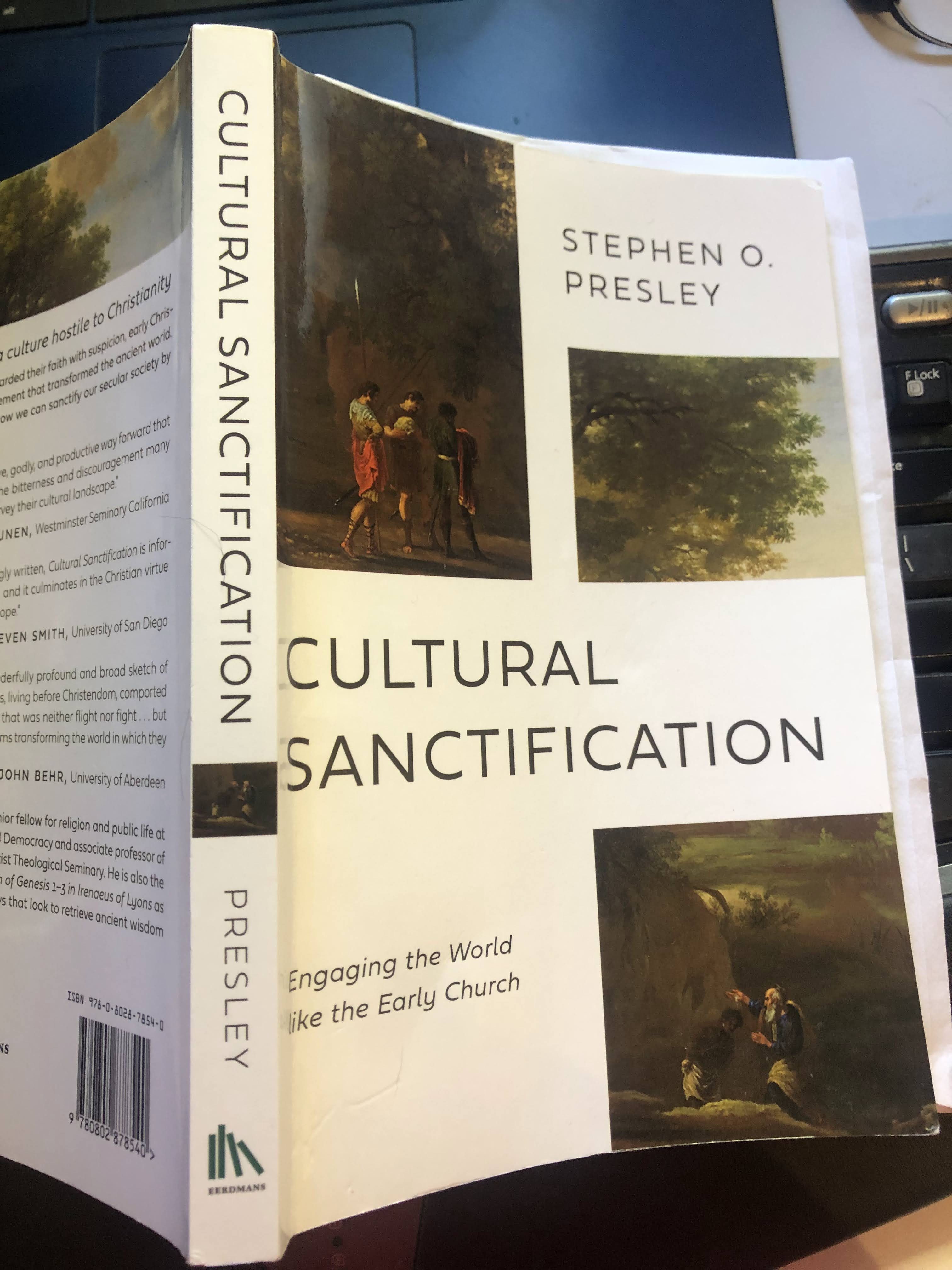
Cultural Sanctification by Stephen O. Presley, is a fairly short book only 169 pages minus notes and bibliography but I found it to be a very dense and thought provoking book. Presley’s premise is that in our postmodern world “everyone is secular, and the public square is filled with a range of moralities competing for the same cultural real estate.” Modern Christians therefore find themselves living and navigating not in a culture dominated by tacit acceptance of Christianity but one where “its moral claims frequently run contrary to new expressions of social progress and moral diversity.” This moral diversity and secularity he argues leaves modern Christians living in a pagan culture not unlike that of second century Rome. The questions confronting modern Christians and those of ancient Rome are similar– do we choose engagement or isolation? Presley takes the stance that we should choose engagement over isolation, but confrontational engagement is not the answer. Instead, we must see ourselves as missionaries in a foreign culture. He writes that “we are all de facto missionaries living among the modern pagans in our neighborhoods, towns, cities, and states, pulled between calls to retreat and calls to confront.” This is where “Cultural Sanctification” comes to life; modeling our behavior on that of early Christians. Second century Christians understood that they were embedded in Roman culture “and must seek sanctification (both personal and corporate) in a way that draws upon the forms and features of their environment to transform them by pursuing virtue.”
Presley breaks down this pursuit of virtue within a pagan culture into 5 areas of Christian life; Identity, Citizenship, Intellectual Life, Public Life and Hope. In each chapter he explains how early Christians pursued virtue in these spheres and then how modern Christians can model our own personal and public lives in the same way. While “virtue” or being “virtuous” can have a negative connotation in our modern context Presley uses this word in its purest form– to be virtuous is to be honorable, ethical, faithful, moral, kind and good.
3 reasons why I liked it
My primary reason for liking this book is that it has refined my thoughts on how Christians individually and the Church corporately can and should interact as Citizens. As far back as I can remember the Church has pursued both political allegiances and power in the U.S.. Whether it was the Moral Majority of the 1980’s, CitizenLink (formerly Focus on the Family Action) or the current President’s Religious Liberty commission, the Church in the U.S. has had a very difficult time separating itself from the State. In my opinion, this weakens the Church first by making it hard to authentically speak truth to power, and second by shifting the conversation toward “law” and away from a conversion of the heart . Presley in the chapter on Citizenship writes “In the world of Christendom, Christians often focused their efforts on transformation, hoping to change the culture through political means. But our only hope in life and death lies not in such political victories [emphasis mine] but in the basic theological confession that we belong to God.” We are ultimately, Presley reminds us, Citizens of God’s kingdom and our hope doesn’t lie in the “glory of Rome”, or more broadly any nation’s glory. Early Christians understood they ought to respect and pray for the State, but did not find their identity in the State (or in our modern world political ideology). This has been a timely reminder for me, that as a Christian I need to respect and pray for our elected leaders (regardless of political views), while engaging those same political leaders with Gospel truth.
My second reason for liking this book is the concept that early Christians saw themselves as missionaries in a foreign culture. As citizens in God’s Kingdom, they had to reorient themselves to how they interacted with the broader culture. Living and working within the Roman Empire, without succumbing (or backsliding) to the broader social mores and customs. Second century Christians sought to live as missionaries, shaping all facets of their lives to God. The Church by virtue of its beliefs and the behavior of believers was noticeably distinct from the surrounding pagan culture. This is a good reorientation for us in the modern world– Christians should not only profess but act in such a way that causes notice. Seeing ourselves as missionaries would help us to better embody”being of the world, but not in the world”. We’ve done so much in the past few decades to be “non-threatening” and “just like you only saved”, that many Christians and churches are indistinguishable from the surrounding culture. But new Christians are seeking something higher than what our pagan culture can offer. They are flocking to both the Catholic and Orthodox churches because they are distinct and unlike many Protestant churches do not offer a reflection of the world but something separate and holy.
My third reason for liking this book is the idea that we inhabit a modern pagan culture and the challenges we face are not unlike the challenges that early Christians faced. Our modern day agoras, plazas and communal spaces are awash with pagan “theology”. Whether it’s the theology of self- actualization, political salvation and dare I say it– Christian heresy (to name just a few) we need to exercise our “virtue” muscles and lovingly engage as missionaries. While I wasn’t in wholesale agreement with all of Presley’s suggestions for how we can engage with our modern world I did find the book engaging and it has reshaped my thinking regarding the multitude of messages and “competing moralities” that bombard me on a daily basis.
Should You Read It?
Maybe. In places I found this book overly idealistic, and singularly focused particularly in looking back at our Christian predecessors. As with most of history we only hear from a small privileged segment of society and not the whole. In this respect we get an idealized version of educated, somewhat affluent Christians. We don’t understand how those on the margins may have navigated within the wider culture which I think could leave the reader with some false aspirations. While I ultimately enjoyed the book and as I said before found it thought provoking– unlike some of the other books I’ve shared there isn’t much from a practical perspective that church leaders can take away. If you’re looking for a book to expand your thinking on how to better interact with our broader culture, this is a good one. If you’re looking for practical advice that you can put into action– this isn’t the best choice.
Leave a Reply